

The Institute for Mergers, Acquisitions and Alliances (IMAA) hosted an engaging webinar on people challenges in post-merger integration. It explored how these challenges are often more complex and more consequential than organizations anticipate.

Moderated by David Olsson, Managing Director at IMAA, and Anne Kampf, Business Advisor and Author, the session brought together two expert practitioners. The first was Gabe Langerak, International Total Rewards Leader and CEEMEA Head of M&A Consulting at WTW. The second was Abdulmalik Al Balushi, Group Chief People Officer at ASYAD Group, who is also currently serving as Integration Director on a live cross-border deal with a UK-based logistics technology company.
The session tackled people challenges in post-merger integration as the first in a series of PMI-focused discussions. It aims to hold space for genuine, intellectually curious conversation — not to sell frameworks.
Setting the Scene: People Challenges in PMI
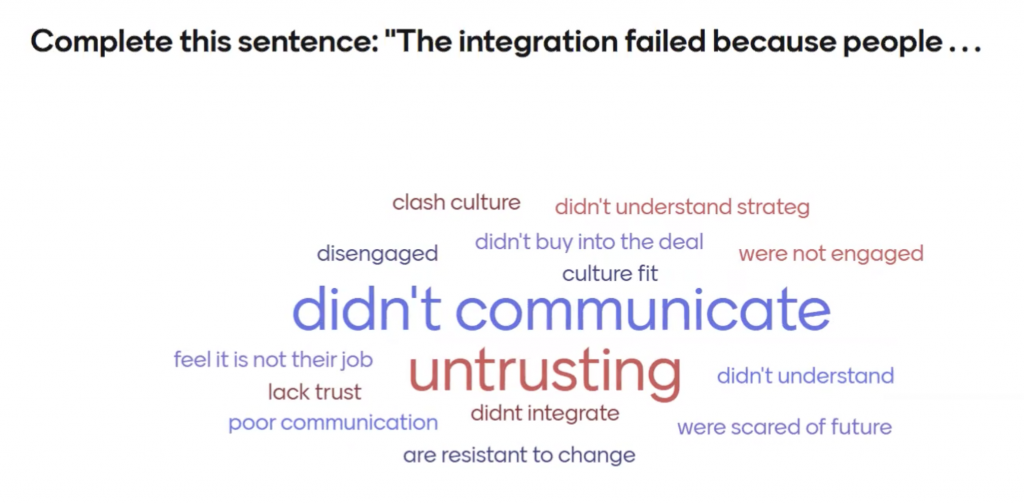
The session opened with an audience poll asking participants to complete the sentence. Audience responses revealed a pattern: almost every word described behavior, not conditions.
As Anne noted, almost all the words described behavior, not conditions: “It’s interesting how quickly organizations personalize integration tension. Most of these words describe behavior. Very few describe conditions, which may already tell us something.”
David picked up on the theme of identity: “When people work for a brand they are proud of, a merger or acquisition can feel like a personal loss. The question is not just whether the deal makes financial sense, but whether people can still recognize themselves in the future organization.”
The Real Issue of People Challenges in PMI: Lagging Indicators vs. Root Causes
When organizations describe something as a “people challenges in post-merger integration,” they are usually observing a lagging indicator. What they rarely do is trace it back to what actually caused it.
Gabe offered a reframe that anchored much of the conversation: “There are elements that have happened before that you could have predicted, that could have stopped that from happening. That, I think, is the biggest thing.”
The shift happens when you understand why people are doing what they are doing. It means moving from treating symptoms to addressing the root causes.
Culture, communication failures, and clashes in leadership style emerged as the most consistent culprits. Gabe recalled situations where leaders, themselves misaligned or poorly briefed on the rationale for a deal, gradually poisoned their teams against the transaction through behavior and language with lasting damage.
The Risk Everyone Names and Nobody Plans For
A recurring frustration among the panelists was the gap between what leaders say and what they actually invest in. As Abdulmalik put it plainly: “Every leader will tell you their number one risk in an integration is culture. Yet the lowest amount of time spent is on culture.”
Gabe challenged the common belief that culture cannot be measured. One practical method he described is to ask the leadership teams of both organizations to complete a self-assessment of their own culture, then ask them to assess how they perceive the other company’s culture.
Mapping the two against each other creates a conversation. Not about right or wrong cultures, but about hidden assumptions and mismatched perceptions that, left unexamined, become fault lines.
David added another layer of complexity: culture is rarely uniform within a single organization. A leader’s own experience can shape their view of company culture more than how people actually work on the ground.
In large organizations with multiple business units or geographies, markedly different subcultures can coexist. This is a reality that becomes especially consequential in a deal.
Abdulmalik illustrated this from his own context at Asyad, where the culture of a logistics division differs significantly from that of the ports or post businesses — even though employees share the same employer, nationality, and often the same building.
When Alignment Fails Quietly
Anne asked Gabe about leading indicators: When does misalignment start showing up before anyone names it?
His answer pointed to the value of early listening strategies — pulse surveys, employee champion networks, consistent engagement from day one — not just as data collection, but as a visible signal that the organization is paying attention and intends to act on what it hears.
David added a note of caution about the limits of town halls and open-mic sessions. Silence in a large room does not mean people are aligned. It often means they do not feel safe enough to speak, or do not yet know what questions to ask.
The real temperature of an organization is taken through direct, human-to-human contact. That, however, requires leaders who are willing to act on what they will learn.
Resistance Is Not the Problem. It Is the Signal.
The conversation turned to the nature of resistance itself. Anne offered a distinction that reoriented the discussion: “Resistance is sometimes less about unwillingness and more about unresolved contradiction or uncertainty.”
When employees appear resistant, they are often responding to a loss of predictability, stability, and role clarity. It is not the idea of change itself they are pushing back on. Gabe observed that people naturally seek certainty when things become uncertain: “As an employee, I couldn’t care less about the wonderful opportunities for stakeholders. I want to know what’s happening to me, to my job, to my team.”
This led to a discussion of the need for more tailored communication — segmented by business unit, function, and even country — rather than one-size-fits-all messaging. Gabe drew an analogy to social media algorithms: people engage more when information feels relevant to them personally.
Abdulmalik reinforced the cultural dimension, sharing an example of a retention scheme in one country that was rejected by a leader because it was not extended to the entire team. The message: what motivates people varies significantly across cultures and geographies, and assumptions imported from one context often fail in another.
The Trap of Speed and the Value of Pre-Planning
Abdulmalik described a pattern he has seen repeatedly: “Under pressure, we forget that we are doing things fast. And we start losing sight of the damage we are creating.”
Gabe offered a counterintuitive point about timing: the period immediately after a deal closes is actually the most powerful window for change. The acquisition itself creates the burning platform.
Wait too long, and that moment passes. Any subsequent changes then become harder to explain and harder to implement.
David brought the thread back to governance and sustainability. Change management is too often treated as a separate workstream rather than as the foundational logic of the integration design itself. A compelling reason for change, a clear vision of the future, and a credible plan to get there are not communication outputs — they are the architecture that everything else is built on.
Closing Provocation: The Real Question Isn’t Resistance, It’s Absorption
David closed by observing that if people are important enough to the combined business, the organization will find a way to keep them — through investment, through structures that give them space, through whatever it takes to press the right buttons. If they are not, they will leave.
Anne offered the final word, and perhaps the sharpest provocation of the session about people challenges in post-merger integration:
“Maybe the question is not why do people resist, but what exactly are people being asked to absorb?”
This was the first webinar in a series of PMI-focused discussions hosted by IMAA. Upcoming sessions will explore technology in integration, integration strategy, and value creation. Stay tuned via IMAA’s LinkedIn and website for dates and speakers.




Stay up to date with M&A news!
Subscribe to our newsletter