


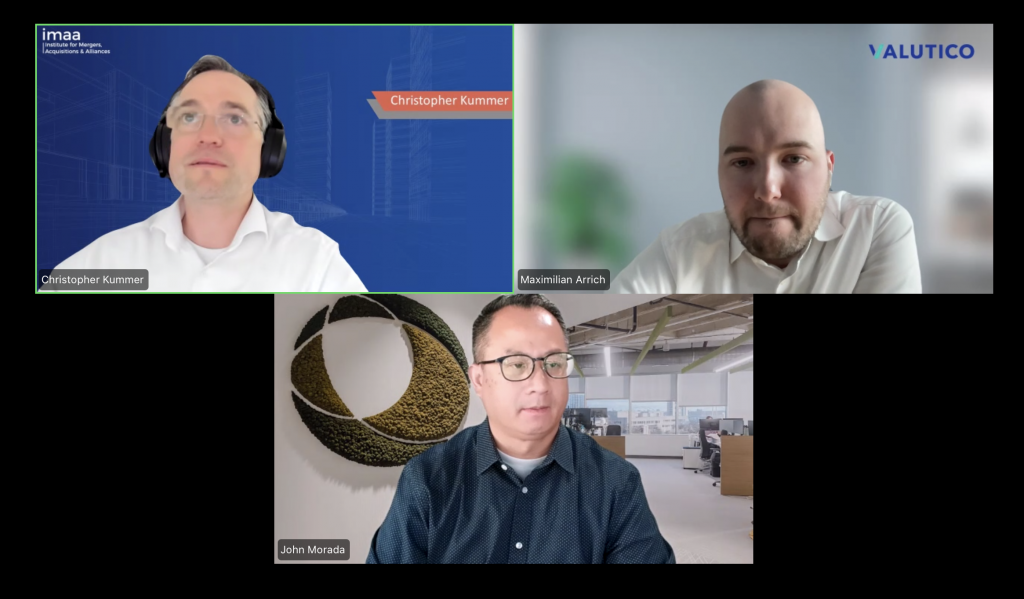
The opening session of the AI in Mergers and Acquisitions Webinar Series brought together two practitioners working at the intersection of artificial intelligence and dealmaking. Maximilian Arrich is the AI Research VP at Valutico, a company building valuation and AI automation software for M&A. John Morada is a Managing Director at ALM First, leading clients through end-to-end M&A integration from deal inception to Operational Day 1.
The session was moderated by Prof. Dr. Christopher Kummer, Founder & CEO of Institute for Mergers, Acquisitions and Alliances (IMAA).
Why Generic AI Tools Fall Short in M&A
One of the first points Max raised cut straight to the heart of the problem. You cannot just plug a data room into a general-purpose AI tool and expect meaningful results.
On the surface, the approach seems straightforward. Simply take the documents, feed them into an AI chatbot, and run an analysis. In practice, M&A creates a set of constraints that make this approach inadequate.
Most fundamentally, M&A is an adversarial information environment. As Max put it, there are always two sides of the information. One party is disclosing it, the other is analyzing it. By default, these two parties do not necessarily share the same interests.
Historically, sharing tens of thousands of documents with a counterparty carried a natural limit. No human team could read through all of it thoroughly. AI removes that limit. “Now with AI, you can scale analytics and you can really find the needle in a haystack, even if the haystack is very, very big,” Max explained.
That changes the risk calculus for both sides of the table.
Beyond the adversarial dynamic, M&A also demands a level of accountability that retail AI tools are not designed to provide. The audit trail question becomes particularly complex in an agentic setting. If an AI agent autonomously reviews hundreds of files to answer a single query, but only ten of those documents appear in the response, what constitutes “access” for logging purposes?
As Max described it, “You might enter a prompt into the chatbot, it might go out, look at several hundred documents, and then distill some information from that for you. It might have looked at 100 documents, while only 10 of those are really relevant in the answer.”
Confidentiality adds a third layer. “You wouldn’t want to share any kind of sensitive information with OpenAI or Anthropic or any kind of third-party software provider,” Max said.
The environment must be locked down with explicit access controls. These should govern not just human users, but AI agents acting on their behalf. This includes careful consideration of privilege escalation as agents are deployed across multi-party deal environments.
From RAG to Agent-Controlled Computers: A Technology Shift
Two years ago, Valutico began building an AI-native Virtual Data Room (VDR) for mergers and acquisitions. At the time, the dominant technical approach for AI document analysis was Retrieval-Augmented Generation (RAG).
Max described it as an AI that looks at snippets pulled from a search result. The model would search a document corpus, retrieve relevant fragments, and synthesize a response from those pieces.
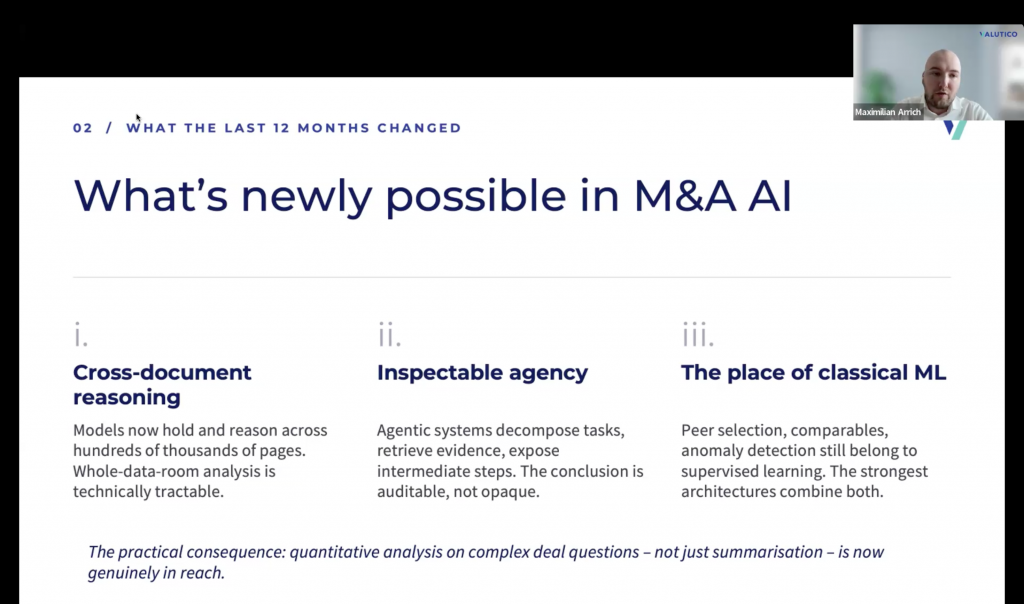
That paradigm has shifted fundamentally. RAG’s core limitation was structural — it couldn’t perform the aggregate, structured analysis that M&A actually requires. “You have a CSV or an Excel spreadsheet with several thousand lines of information, by just issuing a search and then showing the results of the search, you’re not going to get good analysis there,” Max noted.
What has replaced this approach is considerably more powerful. “What we do now is this,” Max explained. “If you fire up an agent for running some M&A analysis, we basically set up a computer, download all the documents that the agent has access to, and then give the agent full control over that computer.”
That means the agent can write Python scripts for quantitative analysis, build Excel models, and generate PowerPoint presentations. The scope of what AI can do in a due diligence context has expanded dramatically as a result.
This shift also intensifies the traceability challenge. A more powerful agent requires more robust oversight. Max noted that progress in agent orchestration has kept pace with the expanded capabilities. This is the practice of one AI agent monitoring and coordinating another.
Classical machine learning also has a role to play. Valutico applies it to peer selection and comparable transaction identification within its valuation tool. “There is no hard right or wrong when it comes to peers or comps,” Max said. “It is more like an art.”
He explained how the system learns from user behavior over time to refine its recommendations.
AI coding tools have accelerated the iteration cycle considerably. The result, in Max’s words, is algorithms that are far more performant than they were a year ago.
A Practitioner’s Map: Where AI Actually Fits in the M&A Lifecycle
John Morada approached the topic from a different vantage point. His focus was not the technology itself. It was the process that technology must serve.
At ALM First, the firm has mapped its five-stage M&A lifecycle. Against that framework, it has identified specific tasks where AI is already in use, under evaluation, or deliberately kept human.
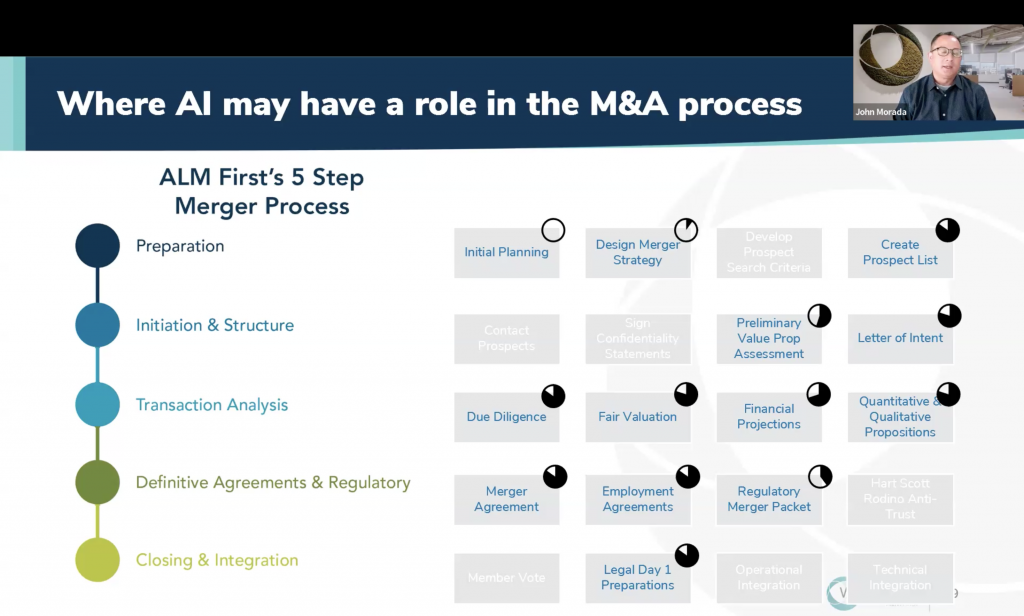
One of the clearest governance principles John shared: “We do not allow 100% of our AI to govern an entire task or process, we always institute a version of human intervention and human final qualification and quality check on the actual outcomes.”
This is not a temporary measure. It reflects a considered view that AI, at this stage, is a complement to human judgment, not a replacement for it.
Trust Is Built Through Confidence, Not the Reverse
A recurring theme in John’s presentation was the relationship between confidence and trust, and the importance of not skipping steps.
“The beginning was we had to ensure that the quality of the responses actually met our own internal quality to give us the confidence that we were getting what we needed,” John explained.
From there, as outcomes improve and training deepens, confidence gradually becomes trust. “Every time we have a better result from the work that we do when we advise our clients, it increases our ability to trust our process.”
At ALM First, they are still firmly in the confidence-building phase. John was candid about the uncertainty: “Should we get to trust in the next six months? I can’t say. Is it nine months? I can’t say either.”
What he was clear on is that trust cannot be manufactured, it is earned incrementally through the quality of actual deal work.
The practical implication for teams: start with lower-stakes, easily verifiable tasks to build the feedback loops that develop real confidence. “Take a lightweight approach to outcomes in the beginning,” John advised.
Attempting to shortcut this process risks introducing errors into consequential work before the team has developed the judgment to catch them.
What’s Changing in Organizations and Teams
John also addressed the organizational shifts that AI in mergers and acquisitions is driving, regardless of how ready teams feel.
“It is absolutely changing the way that we think,” he said. “We have to think differently in how we use AI to complement our work, as well as how we take the results and increase that confidence level, which then turns into trust.”
On workforce implications, John was direct: “I wish I could tell you that everybody’s going to have a job even with AI as part of our market. I’m not here to tell you that.” What he did say is that AI is, at this point, a complement and that organizations need to build foundational understanding across their teams before moving forward.
“If we skip a step, there will still be too much potential for misinformation or a deviation from what we need to establish as a strong foundation.”
The Question of Specialized Tools
The Q&A surfaced a question that many practitioners are wrestling with: should the industry expect one comprehensive AI platform for mergers & acquisitions, or a continued plurality of point solutions?
Both speakers pointed toward plurality, at least for now. “What I haven’t found yet is one overall solution that can do everything,” John said. “From the point that you start from the very top under preparation, all the way to the very bottom around closing integration — there are point solutions that serve what you need to do today, but we don’t have a general one that is the best-of-breed, holistic AI program that does everything.”
On the question of industry-specific specialization, Max offered a nuanced perspective: “The intelligence of an AI model in general is pretty broad — you will find, especially with the latest generation of models, that they have pretty deep knowledge in any kind of niche almost.”
Model-level specialization is therefore not where differentiation is coming from. What does drive specialization, he argued, is proprietary data, tooling, and environment: “We do see a lot of specialization in the data that’s available and also in the tooling that integrates it and in the environment.”
John echoed this with a practical example from his own niche: “If I were to build one, I would pick the 1,600 credit unions in my industry and I would basically build my entire search engine around that.”
That kind of deep vertical focus, grounded in specific data sets and user needs, is where he sees meaningful differentiation emerging.
Both speakers also flagged a signal-to-noise problem in the market. “You see a lot of people with no M&A experience come up with this usual influencer thing,” Max noted.
“If you take a look under the engine, I think it’s a lot of crap to be honest.” Over time, what survives will be tools and frameworks that genuinely understand the constraints of the deal environment.
Understanding the technology alone will not be enough.
Key Takeaways
For practitioners looking to develop a concrete starting point, the session offered several actionable principles:
1. Understand your governance policy first.
Especially in regulated industries, compliance constraints define the boundaries of what is permissible before any tool evaluation begins.
2. Map your process before selecting tools.
Knowing where you want to apply AI in mergers and acquisitions matters. And knowing where you don’t want to apply it matters just as much.
3. Start lightweight and validate.
Low-stakes, easily verifiable tasks build the feedback loops that develop genuine confidence in outcomes.
4. Always maintain human oversight.
No task, at this stage, should be fully delegated to an AI system without a human quality check at the output stage.
5. Treat AI as a complement.
The organizations building effective AI in mergers and acquisitions practices in M&A are enhancing human judgment, not replacing it.
The series continues with upcoming sessions covering origination, due diligence, AI-driven valuations, and a dedicated look at specific tools in use across the M&A lifecycle. A session with Professor Aswath Damodaran on investing in the age of AI is also forthcoming.



Stay up to date with M&A news!
Subscribe to our newsletter