


The latest session of IMAA’s Applied AI in M&A Webinar Series explored the growing role of AI in valuation and M&A — and asked a harder question than most: when AI can read everything you have ever written, watch every lecture you have delivered, and replicate your spreadsheets on demand — what exactly are you still contributing?
That question was put directly to Prof. Aswath Damodaran, Kerschner Family Chair in Finance Education and Professor of Finance at NYU Stern School of Business, and one of the world’s foremost authorities on valuation.
Damodaran has spent decades making his entire body of work publicly available — papers, books, blog posts, and spreadsheets on topics ranging from corporate finance to AI in valuation and M&A. He has also uploaded more than 1,300 lectures to a leading video platform, making his full curriculum freely accessible to anyone in the world.
That openness makes him among the most exposed professionals in finance to the disruption he came to discuss.
The session was moderated by Prof. Dr. Christopher Kummer, Founder and CEO of IMAA.

The Damodaran Bot: A Two-Year Experiment
About two years ago, a colleague at NYU’s machine learning faculty reached out with an unexpected proposition. His team had built a ‘Damodaran bot’ — an AI entity trained on every piece of content Damodaran had ever made public, designed to value companies the way he does.
The experiment was simple. Students in his class would value companies of their choosing. The bot would value the same companies independently. Damodaran noted the uncomfortable symmetry: if the bot outperformed his students, the implication was that teaching the class was pointless.
If it underperformed, decades of public content had failed to transmit the craft.
Two years on, his verdict is measured but unmistakable. If the bot were a student, it started at a B and is now approaching a B+. “It’s terrifyingly competent,” he said. “For those of you whose vision of AI is an early version of a general-purpose AI chatbot, you need to let it go.“
Four Dimensions of Exposure
Rather than offering a blanket verdict on displacement, Damodaran proposed a diagnostic framework. He outlined four dimensions along which any professional can honestly assess their own vulnerability.
1) Mechanical versus intuitive.
A landmark AI chess programme beat every chess grandmaster by memorizing every counter-move to every known position. If your work follows a similarly fixed procedure, a machine will do it better.
2) Rules-based versus principles-based.
Accounting is deliberately rule-driven. The Financial Accounting Standards Board (FASB), Generally Accepted Accounting Principles (GAAP), and International Financial Reporting Standards (IFRS) are effectively codebooks that leave little room for independent judgment.
Feeding rules into a computer makes replication straightforward. Fair value accounting was already being automated before generative AI arrived.
3) Objective versus subjective.
The judgment calls that cannot be derived from an equation are precisely those most resistant to automation. “Be glad for the part that’s subjective,” Damodaran said, “because that’s the part that machines will have a tougher time replacing you on.“
4) Open assessment versus predetermined conclusion.
If the valuation starts with the answer and works backwards, the analysis becomes what Damodaran called ‘the kabuki dance.’ AI can execute that process faster and more consistently than any analyst.
“Trust me, a leading AI model can do that better than you can,” he said.
Where the Human Advantage Lives
1) Cross-domain connection
When an Icelandic reader asked how to handle lava risk in a resort valuation, Damodaran took his dog for a walk without his phone. Over 35 minutes, his mind moved from lava to fossil fuel multiples, to DNA data breaches, to earthquake risk near his San Diego home.
That wandering train of thought led him to a broader insight: that humans rationally exclude catastrophic risk from expected-value calculations — not out of irrationality, but out of necessity.
That walk became a widely-read blog post. A phone in his pocket would likely have prevented it.
2) Narrative embedded in numbers
Every valuation tells a story, and the numbers are only as valid as the story they encode. The bot can construct a reasonable narrative. However, it still misses the wild cards that do not appear in financial statements.
In a recent valuation of a major Chinese electric vehicle manufacturer, it handled the industry dynamics and financial projections competently. It missed the role of the Chinese government entirely: a variable neither easily quantified nor consistently disclosed, but one that shapes every material outcome for the company.
3) Reasoning as a practiced skill
Damodaran described what he calls the ‘Google curse.’ It is the growing habit of retrieving answers rather than reasoning toward them. “Reasoning is a muscle. If you stop using it, evolution takes it away,” he said.
The professionals who have kept that muscle active will be disproportionately hard to automate.
The Scam as a Capability Test
While hiking in the Sierra Nevada, Damodaran discovered an AI-generated social media scam had fabricated an investment fund in his name. His response was to grade it.
On surface presentation, the scam earned an A-minus. This included writing style, company selection, and even AI-generated voice synthesis that closely replicated Damodaran’s audio tone.
On content, a C-minus. It asserted stocks were undervalued but offered no substantive reasoning. And it made a critical error: it asked people to send money. Anyone familiar with Damodaran’s actual positions would recognize that immediately as a false note.
He has maintained a longstanding refusal to give investment advice or take on commercial engagements throughout his career.
His conclusion: voice and words are now highly replicable. The internal consistency of a body of work built over decades is not.
Pascal’s Wager for M&A Professionals
Damodaran closed with a framework from philosophy. Pascal argued the asymmetry of outcomes makes belief in God rational regardless of probability. The same logic applies here.
Professionals who prepare for AI disruption give themselves a fighting chance. Those who do not will find themselves blindsided when the shift arrives. And should the disruption never fully materialize, the preparation will have made them better at their work regardless.
“Preparing for my bot makes me better at teaching and valuation, because it forces me to think about what I bring to the table that’s not mechanical,” he said.
Key Takeaways
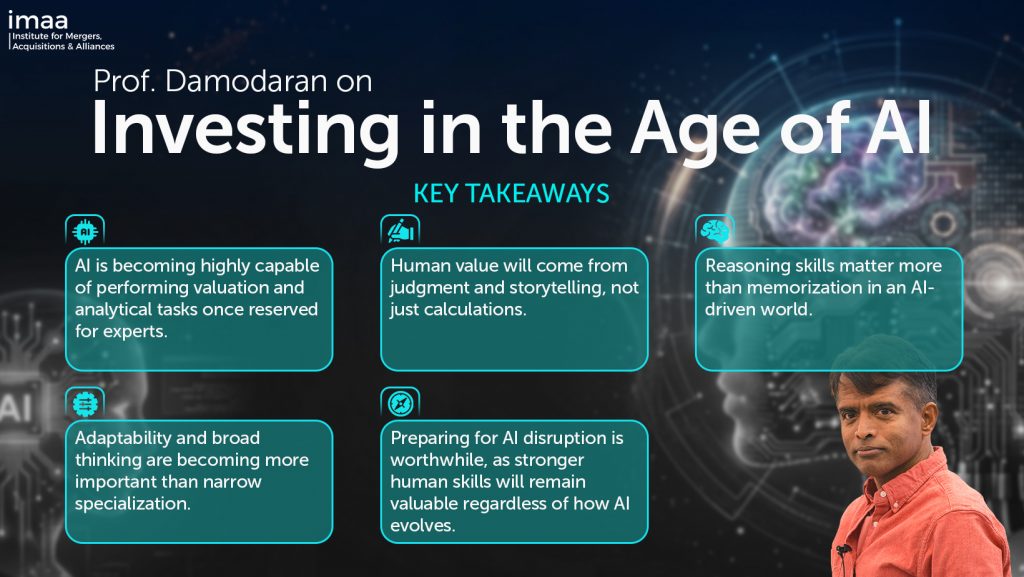
If there was one thread running through the entire session, it was this: the professionals who will thrive are not those who resist AI, but those who understand exactly what it cannot yet do.
The session’s key themes are captured in the graphic below.
The Applied AI in M&A Webinar Series continues with upcoming sessions on due diligence, AI-driven valuation, and integration planning. Professor Damodaran’s full valuation training program is available through IMAA.



Stay up to date with M&A news!
Subscribe to our newsletter